| Research should begin two weeks to a month prior
to your departure. Taking the time to sit down and read
about the place enhances our overall experience, whether
our destination is close to home or an exotic location.
Obtain information on the history, location, climate,
customs, food, and culture. This will start to build
up excitement and will fuel that thing called passion
that you already have for your photography. Local libraries
and bookstores are a good place to start. Speciality
travel series such as Lonely Planet, Moon, etc. offer
a wealth of knowledge. You should also check out the
country’s requirements for visas, and always carry
a passport. If you are travelling south, consult a travel
doctor and find out if your shots are up to date and
if malaria tablets are necessary. I will include a Web
site here for lots offree downloadable information.
Some people might say, “Well, I didn’t get
sick on my last trip.” It’s like putting
on a seat belt in a car: you do it to be safe. Find
out about medicines and bring an ample supply with you.
Check out www.broadviewtravelclinic.com
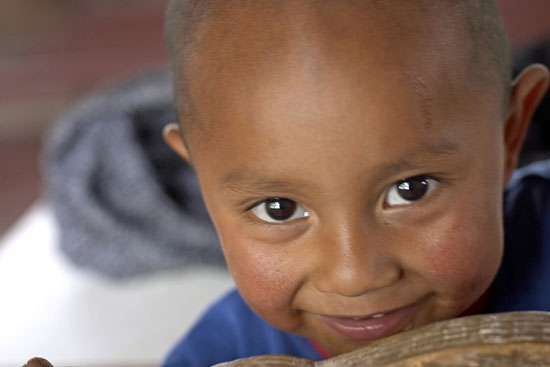 |
Smiling eye, Ocumicho, Michoacán,
Mexico
Children are great, always interested in what
you are doing. If you take your time and let them
become part of the process, rewards will follow.
The digital age has allowed us to become more
involved with the creative process. When I showed
this young boy the instant image on the back of
my camera, he was more than willing to keep letting
me capture something special. On my D-SLR, my
50mm becomes an 80mm portrait lens. |
Packing
Give yourself ample time and space to do this chore. I
break this process down to three categories: camera gear,
personal belongings, and clothing and essentials. Let’s
skip the cameras for now and start with the other items.
I am getting better but I still take too much. Most of
my trips are three weeks long, and I plan on doing one
or two washings during my trip. this seems to cut down
on the amount of clothing that I bring. Try laying out
the items on your bed and visually go through everything
before you pack. Do you really need two pairs of shoes,
pants, etc.? One suggestion is to take a bag just big
enough to pack your tripod. Take the head off and bubble
wrap it (it will go in your carry-on). Bubblewrap the
legs also, and double protect the parts by placing your
folded clothes around them. Remember this will be the
bag that you check in and will go into the belly of the
plane. Any sharp objects should also be included in this
bag.
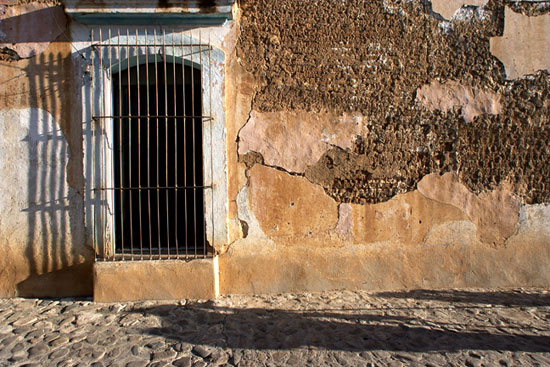 |
Weathered wall, Oaxaca, State
of Oaxaca, Mexico
Textures run rampant in this photograph, but for
me the duelling shadows complete the composition.
The shadows created by the ironwork balance out
the shadows created by the 2 photographers working
to my right. My camera was on a tripod, which
slowed me down and afforded me the time to notice
this in my composition. Careful placement of all
the ingredients, sometimes by moving the camera
only one inch, makes all the difference. Shot
with a 14mm rectilinear f2.8 lens at 1/125 at
f7.1. |
This might be a good time to go out and buy a new travel
bag. I use the soft type – either a ski or hockey
bag, available at most sporting goods stores. Some of
them have wheels on one end, a boon for lugging them
through airports and going from one hotel to another.
They also have large outside pockets, ideal for carrying
your personal care items. It is wise to break these
items up and separate them into ziplock bags in case
of leaks. Small, seal-tight containers are available
at all Mountain Equipment stores. Pack the heavier objects
at the bottom of the bag.
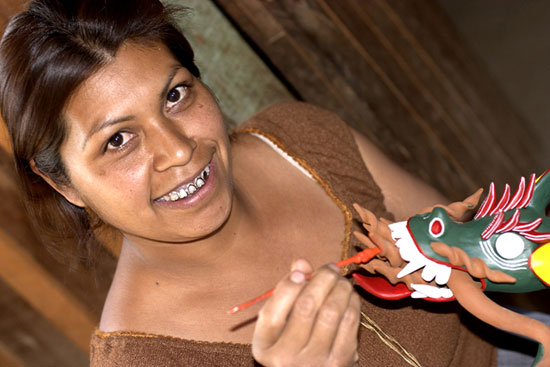 |
Zenaida, Ocumicho, Michoacán,
Mexico
This artisan uses a tapestry of colours to paint
her wonderful creations. I used a little fill
flash with the normal lens to brighten up her
smile and eyes. Shot at f2.8 and 1/15 second,
with a 50mm 1.4 lens (one of my favourites). |
On most airlines you may carry on up to two portable
bags, which are restricted as to size and weight. This
is where all your camera gear should go, including film,
laptop and storage devices. I use all Lowepro bags.
They are designed and used by experienced photographers,
and are very affordable. They also bear an indication
of which ones are airlineapproved for carry-on.
Choice and quantity of equipment differ for all photographers.
I will describe the system that has worked for me over
the past few years. Since I conduct photographic workshops/
tours, I carry a fair bit of gear. My two carry-on bags
are the Road Runner AW Mini and the EX 1200. In the
checked piece of luggage I also carry a day bag, the
SlingShot 200AW, which in my opinion is one of the best
designed camera bags to come out in years. I will discuss
this later in detail.
All my camera equipment fits into the Road Runner AW
Mini. This includes the cameras: a Canon EOS 10D digital
body, a Canon EOS 1N film body and a Hasselblad Xpan.
Film lenses include an EF14mm f/2.8L USM, a TS-E 24mm
f/3.5, EF 50mm f/1.4, an EF 100mm f/2.8 macro, an EF
20-35f/2.8 mm zoom and an EF 100-400mm F/4.5-5.6L IS
USM zoom Canon lens, plus two Fuji lenses, a 45mm f/4
and a 90mm f/4 for the Xpan. Because the digital camera
chip is set at a 1.6 magnification, the Canon lenses
turn into six additional focal lengths, so now I have
effectively twelve lenses. I also carry my Gitzo G1378M
ball head along with all my spare rechargeable batteries,
and nicads. This is my first carry-on.
In my second carry-on, the EX 200, I am able to pack
all of my rechargeable plug-ins for my batteries, along
with a laptop if need be. I normally carry an Epson
P2000 40G hard drive storage device instead for portability
during my day shoots. I include a power bar for convenience
of doing multiple charges, and a small portable 9x12
P-Frame light table for reviewing transparencies during
the workshops. All my travel books, maps and additional
information travel with me in this bag. Also bring your
camera manuals for reference; you will be surprised
at how many of those seldom-used controls are easy to
find with that manual. My film also goes into this bag,
in clear ziplock bags for visual inspection (cardboard
boxes and plastic containers removed), and further protected
by lead-covered bags. The easier you make it for the
inspectors, with a big smile and lots of thank you’s,
the smoother this part of the trip goes.
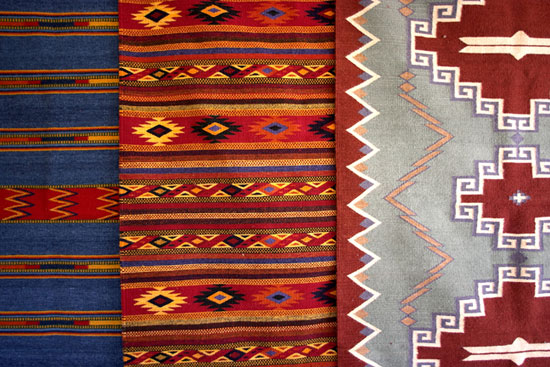 |
Patterns of colour, Teotitlán
del valle, Oaxaca, Mexico
Colours abound in this photograph. By carefully
lining up the lines and rectangular shapes, I
was able to capture artistry that is the legacy
of thousands of years. Using traditional techniques
and natural dyes from plants, the artisans allow
the beauty of these woven rugs to shine through.
Shot with the 14mm lens at close quarters, f2.8
on a tripod at 1/8 second in natural light. |
Two of my students carried all of their equipment in
the new SlingShot 200AW by LowePro. For them, this replaced
my first carry-on, and they carried a small knapsack
for their second bag. Again, this is determined by what
equipment choices you have. This new bag is fantastic.
The ergonomic sling strap is great for both females
and males. Three well-designed compartments ensure plenty
of accessible room for cleaning supplies, back-up body,
light meter, one full body with grip and three or four
lenses. It’s very easy to access your cameras
without removing the bag. Also, you have the added security
of being able to get in and out of taxis without ever
taking off your bag. For me, the SlingShot goes into
my checkin bag. I removed all the portable liners and
filled it with my toiletries in ziplock bags. This is
all I used for photo outings during the trip.
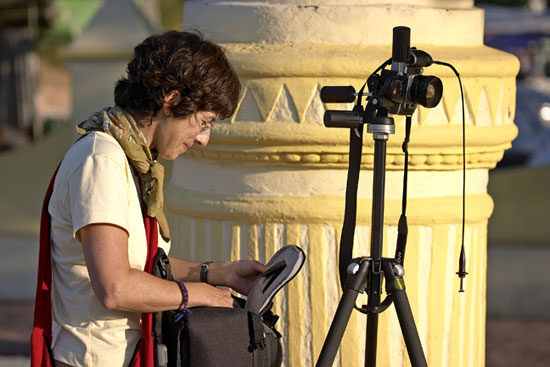 |
Josée’s pick, Campeche,
State of Campeche , Mexico
Easily accessible in just one movement without
removing the bag from your body, this revolutionary
camera bag design sets a standard. Josée, one
of my students, brought all of her gear in this
one bag. |
After all this, to be honest with you I still forgot
two items on my last trip to Mexico – my Leitz
table-top tripod and my sensor-cleaning brush for my
Canon D-SLR. So if you go to my Web site at www.wpmcelligott.com,
my good wife Norma Lu has prepared a very extensive
Equipment Checklist in PDF format that is downloadable.
It is under Equipment Check at the top. If you can think
of anything else to add, please send it to me at: willie@wpmcelligott.com
Other useful Web sites to visit:
www.pdtours.com
www.photolife.com
www.lowepro.com
www.mec.ca
William P. McElligott continues to explore the world
around him through the medium of photography. Completely
self-taught, William is a practising professional architectural
photographer living at Meech Lake in Chelsea QC. He
currently divides his time between assignment photography
and conducting visual design photography workshops and
tours. These workshops take place in Canada, Mexico
and the United States.
|